
The goal of customer profitability analysis is to improve profitability. This article lists some ideas for how to do that.
Profitability Killers
Here is a list of customer profitability killers:
- Multiple Small Purchases: A customer who makes infrequent large purchases will be more profitable than a customer who buys the same amount over the year via frequent small purchases. This is driven by order processing costs.
- Low-Margin Purchases: I’ve noted that the customers who purchase the most units or have the highest sales revenue aren’t always the most profitable customers. Those purchases must be of high-margin items.
- Large Discounts: Some companies use their large purchase volumes to demand large discounts. This may be the most common way that customers with large revenues show surprisingly low profitability when a customer profitability system is implemented. Companies that track revenue but not profit are the most likely to buckle under that pressure.
- Slow or Poor Payments: Customers who take a long time to pay for their items create a working capital burden for the company. Customer profitability systems that don’t capture the working capital impacts of each customer miss this. Bad debts are devastating to profit. In banking, a high-profit customer quickly became a very unprofitable customer when they couldn’t pay back their loans. The loan losses are accompanied by increased collection costs and management oversight. The bigger the customers are, the harder they fall.
- High Customization: Customization usually isn’t the real problem here. What often happens is that a big customer asks for customizations that drive costs, but the company doesn’t ask for payment for that customization.
- Frequent Returns: Returns drive processing costs. They may also pressure working capital with inventory. That inventory may even need to be scrapped or sold for used prices.
- High Customer Service Costs: Some customers make many more inquiries for each order placed. Some customers require high amounts of after-purchase support. These are costs that many companies don’t track at the customer level, especially pre-purchase inquiries.
All these factors are logical. The full list may appear painfully obvious. However, if these factors are not measured for each customer, then a company is blind to the true profitability of each customer. Knowing each customer’s profitability provides the basis and the motivation to deny requests that drive costs or to ask the customer to pay some or all of those costs. The activity costs from an ABC system can be used to justify the amount requested to be paid by the customer.
Here are two factors that are often considered to be indicators of higher profitability. Interestingly, they have been shown to have weak or no correlation with higher profitability.
- Long Customer Life: Customers with both a short life with a company and those with a long relationship can both be highly profitable.
- Cross-Buying: Cross-selling products to a customer can be profitable. Where things go wrong is when low- or negative- margin products are the ones cross-sold. Discounts may be used to entice the customer to buy additional products. Incentives based on the volume of cross-selling compound these problems.
Improving Customer Profitability
Below are ideas for improving profitability. Not all of these should be used for all customers. The next lesson will describe different customer types and which of these ideas are best for each customer type. Many of these ideas promote the opposite of the profitability killers listed earlier.
Improve Cross-Selling
I noted earlier that the problem with cross-selling is often the products that are cross-sold and the price at which they are sold. Focus
cross-sales on high-margin items. Incent employees only for those cross-sales and not all cross-sales. Limit the discounts allowable for these sales. Identify patterns of product mixes of the profitable customers. For customers who have some, but not all, of that mix, cross-sell the missing products or sell the mix at a bundle price.
Charging for Components of Products or Services
Items that are often charged may have been given for free to many customers. When a company implements customer profitability analysis, it may determine that not all of those customers deserve those items for free. A company can also break a product or service into component parts. If many low-profit customers buy a common component and that component has value, then the company may decide to start charging for it.
Ironically, many people are tempted to waive the price for value-added services. The costs of services may seem less tangible than the costs of a physical product. Some people may point out that a large portion of service staff are sunk costs. The devastating impact of starting to waive prices for these services is price cannibalization. It becomes harder and harder to charge for these services in the future. Waiving the price may reduce their perceived value by the customer. The costs of the service staff don’t go away, but the revenue for them does.
Removing Services or Products
Activity-based costing provides a list of resources and activities consumed by each product and customer. A company should challenge whether each of those resources and activities is necessary. From a product perspective, the criterion is whether they provide value to customers. From a customer perspective, the criterion is whether they provide value to the right customers. The right customers are the highly profitable customers or the customers that are able and willing to pay for that value.
Quality Improvements
The root cause of customers with high returns may be the poor quality of the types of products they buy or shipping mistakes. This also lowers their satisfaction and the ability to make those customers profitable. Do a root cause analysis of high-return customers to identify if there are ways to convince the customers to make fewer returns or whether the problem is internal to the company.
Promoting Referrals
I joked earlier that a salesperson may justify action taken in favor of a low-profitability customer by saying that the customer is a great referral source. It’s much easier to justify approving those actions if the customer has actually referred profitable customers to the company.
Promote Actions That Reduce Costs
Some customers drive up excessive ordering and servicing costs. It may be the number of activities (e.g., frequent small orders) or the channel they use for those activities (e.g., those that require company employees to enter or process an order instead of an automated electronic channel).
A company could show a customer ways to change their actions that will save money for both parties. A company may need to provide an incentive for a customer to change activity patterns. This is a form of profit-sharing by the company.
Another option is to charge a fee for channels or activities with high costs. This should be done very carefully. A few banks tried to charge fees for customers to use the expensive branch channel. They received very bad press for this. It was much better to offer incentives to use cheaper electronic channels.
Target Currently or Potentially Profitable Customers
Scarce marketing dollars can be focused on the customer segments that are the most profitable current and prospective customers. These customers can also receive priority for product delivery times and customer service waiting times. This could mean just a reallocation of the same amount of resources or a reduction of resources from increased efficiency. A company can also allocate resources to target customers with a low current profit margin to take steps to improve their profitability.
Change Incentive Systems to Reward Profitability
Many incentive compensation systems reward high volumes of sales units or total sales revenue. Not all revenue leads to the same profit. Switch all or a portion of volume-based incentives to profitability-based incentives. Ways to do this include:
- Compensation based on a percentage of profitability
- Compensation based on increases in profitability in dollars
- Compensation based on increases in a profitability metric
- Compensation only for higher-margin products or at a higher payout rate for those products
Develop a Customer Portfolio Mindset
Customer profitability goes through cycles. That cycle may be driven by how long the customer has been with the company, where the products the customer buys are in their life cycle, and the stage of the economy. Customer profitability assessed historically over the past year captures the relative profitability at a moment in time in those cycles. Companies want to take steps to improve the profitability of customers in the context of future cycles. CLV, product life-cycle analysis, and leading economic indicators can inform this.
Forward-looking modeling and stress testing of individual customers or customer segments is useful. For example, banks stress-test certain borrowers to see if they would be under financial stress in a weak economy or when collateral prices drop. Non-bank companies can do the same for those customers who buy on credit. In summary, companies should look across time when targeting customers.
They may also want to target customers whose profitability cycles at different times than their current customers. More customers who look like their current high-profit customers may not be desirable. This may not lead to higher profits, but may reduce the volatility of the company’s cash flow and earnings, which leads to lower risk and a lower cost of capital. Please check out my course on business portfolio management if you want to explore this further.
Efficiency Improvements
Of course, there are actions that can improve the profitability of all customers. Efficiency improvements for manufacturing, operations, and service delivery reduce costs applied to customers. This may have a small impact on the relative profitability rankings of customers, but can improve the company’s total profitability. Think of them as ways to push the whole whale curve further above water.
Pricing
Some who have studied customer profitability contend that the best way to improve profitability is through pricing. This is especially true for improving the relative profitability of a customer within a company’s customer base.
Companies often charge different prices for the same product to differentiate groups of customers or to different individual customers. Price differentiation is a pricing strategy in which a company sets different prices for similar products to different customers. Price segmentation can be defined as setting different prices for a product for different groups of customers. It can also include setting different prices for different features of a product.
Every customer values products differently and has a different willingness to pay for a product. Setting just a high price means some customers won’t buy the product because they don’t value it that highly or can’t afford the high price. A low price means more customers will buy the product. Some will pay well below what they value the product. They would have been willing to pay more.
Charging different prices for a product to different customers allows a company to set prices equal to the value each customer perceives for the product and their willingness or ability to pay. Different prices for versions of a product allow better matching of the price to the value each customer wants to receive from the product. All of these improve a company’s profits and can better serve customers.
The key to differentiation is deconstructing your products. If your products and your competitor’s products are the same, then value-based pricing says there is no way to justify value differentiation. In that case, the only differentiator is price. The lowest price wins. The lowest-cost producer is the only one who can win the price war, and it may have to endure negative net income to do so.
Pricing segmentation and differentiation are ways that a company can be said to treat similar customers in different ways. Others would contend that these customers have some similar characteristics but value the same product very differently. Once again, a company must decide its answer to this question. If they decide to pursue price segmentation and differentiation, they must also decide who in the company can set those different prices.
Discounting
A key component of pricing and profitability, especially for B2B businesses, is discounting to individual customers. A company can graph the prices paid by customers for a product by volume and by salesperson. A sample graph might look like the graph below. The y-axis of the graph is the price paid per unit. The x-axis is the number of units purchased by each customer in an order.
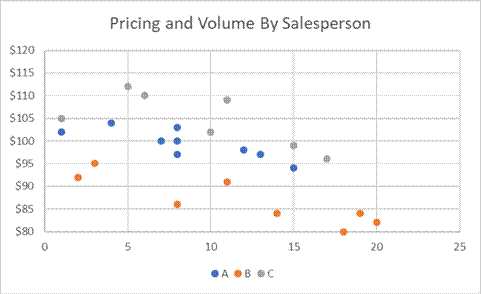
This graph shows a couple of things. First, there does appear to be an inverse correlation between price and volume. The higher the number of units ordered, the lower the price per unit. This may be reasonable for a single product, where higher prices may mean higher profitability. The product mix of a customer with high sales may be what causes them to have low profits compared to a customer with much lower sales revenue.
Secondly, there is a very strong pattern of discounting by the sales staff. One consistently prices higher than the others, one is consistently in the middle, and one is consistently low. This is a way to identify variances in pricing tendencies between salespeople and to help them stay consistent with the company’s pricing strategy. Differences in customer profitability may be due to the customer’s salesperson and not the customer themselves. When there are outliers in pricing within a salesperson’s portfolio, it may indicate customers who are better at negotiating bigger discounts than other customers.
One struggle of getting an accurate picture of true pricing, like that of the previous graph, is that a purchase may have layers of discounts to it. Some systems may not capture all of the discounts given to a customer. A deep dive into specific purchases may identify whether all discounts are being tracked for all customers. One way to do this is via a price waterfall.
A price waterfall is a graphical display to show the difference between the list price for a product and the price a customer actually paid. It was developed by McKinsey and Company. The price a customer actually paid is called the “pocket price.” The difference between the list price and the pocket price is the pocket discount.
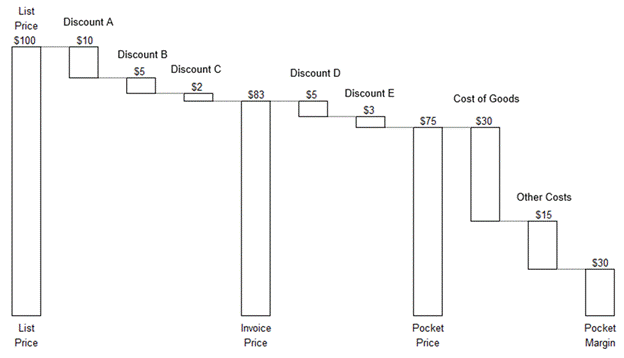
The example waterfall in the image starts with a $100 list price. The customer then receives a series of discounts to arrive at an invoice price of $83. These discounts might be for volume discounts, exception pricing to match a competitor, or one of many other discounts. The customer also receives other off-invoice discounts to arrive at a pocket price of $75. Off-invoice discounts include cash discounts or an annual volume bonus to the customer. The pocket price is reduced by the cost of goods and other costs to arrive at the pocket margin. Other costs might include servicing costs, sales costs, or shipping costs.
A price waterfall tracks the layers of discounts received by a single customer. The map of discounts for all customers is summarized in the plot graphs discussed earlier. A company may identify some customers who received outlier pricing via a plot graph and then build price waterfalls for those invoices to identify the specific reasons for the low pricing.
The systemic question is whether the pocket discounts were derived from a well-developed strategy or are a series of ad-hoc defensive measures with little linkage to an agreed-upon pricing strategy. The discounts may have been given or authorized by a variety of people. The total of the discounts may not have been coordinated.
Rather than raising list prices, often the best way to improve pricing is to find the profit leaks cascading down the price waterfall. Price waterfalls create visibility to the cumulative effect of discounts and their impact on profitability.
I go into much more detail on pricing considerations, strategies, and ideas in my pricing courses if you want more information on pricing.
For more info, check out these topics pages: